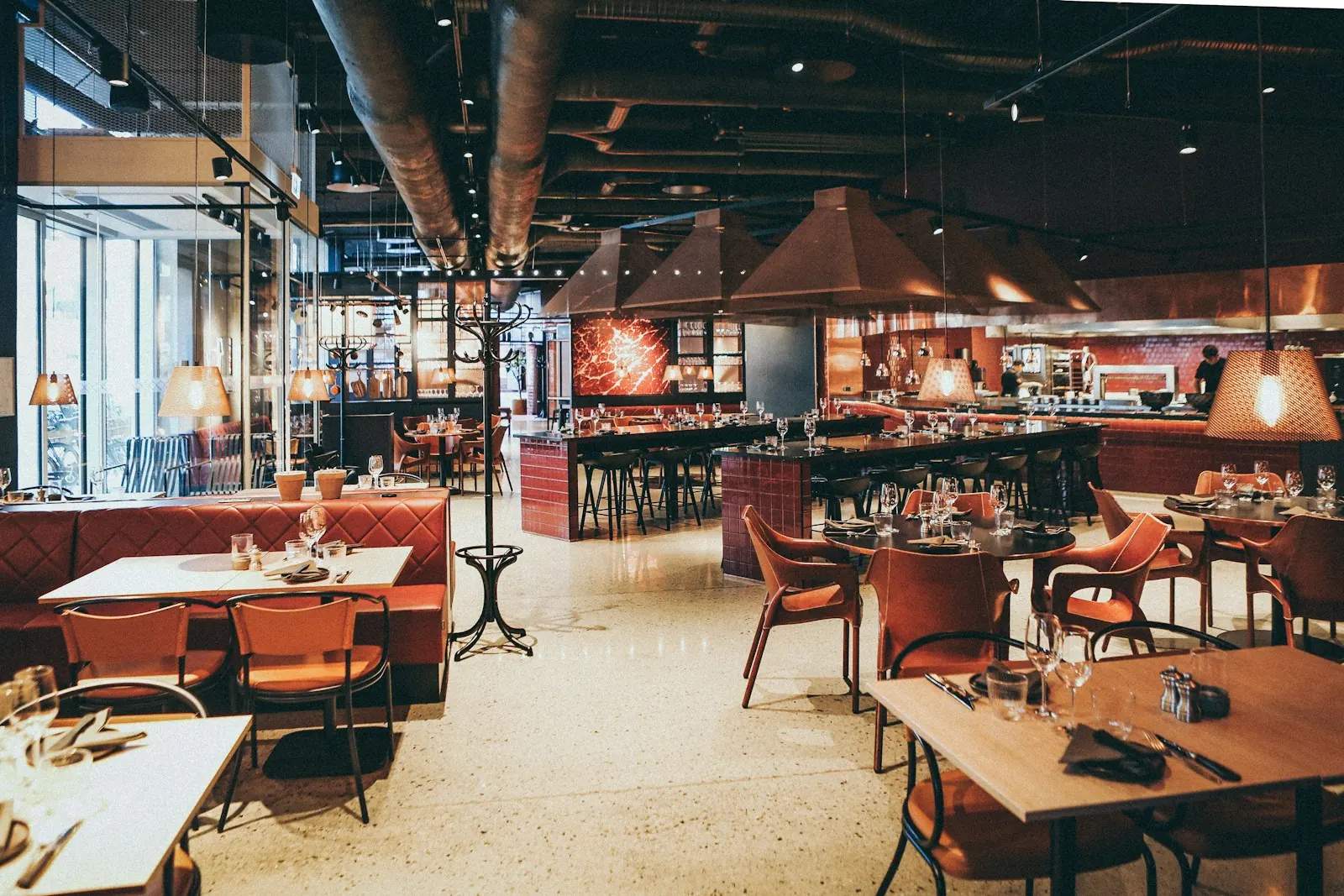
Planning a staff restaurant.

A staff restaurant has two audiences that are rarely considered together: the people who work there and the people who eat there. We plan the place where both worlds meet.

Open kitchen with servery area in a staff restaurant
Corporate catering

The kitchen is the smaller part of the task.

In most staff restaurants the guest area is larger than the production kitchen in floor area. It is where acceptance or rejection is decided anyway: at the counter, on the way through the room, at the table. Yet specialist planning frequently stops at the edge of the servery.

Servery

Which servery system fits?

No system is better in principle. The choice follows from guest numbers, available staff, area, breadth of offer and the length of the time window — and from how the food is produced.

Straight-line servery

One continuous line

A tray slide connects the counters and guests join the line. It needs little area, replenishment happens directly from behind, and portion size can be adjusted in conversation. Under pressure, however, a queue forms — nobody overtakes here. Also known as a cafeteria line or long-line servery.

space-efficientshort routescongestion risk
Free-flow

Separate stations

The defining feature is that the counters are not connected by a continuous tray slide. Everyone walks straight to what they want. It carries high guest numbers and individual stations can be opened or closed as demand shifts — in exchange it requires area, equipment and a circulation layout that avoids crossings during replenishment.

high volumechoiceneeds area
Counters & food court

Independent units

Physically separated counters with their own cooking equipment, their own storage and often their own till. Dishes are produced in front of the guest, holding times are short and surplus production is low. The price: the equipment installed determines what can be cooked there in future.

freshnessexperienceequipment binds
Digital & grab-and-go

Alongside the servery

App pre-ordering with collection, self-checkout, self-service chilled display, micromarket or collection locker. It replaces no counter, but relieves the lunch peak and serves everyone whose working hours do not match the serving window.

grab & goself-checkoutpre-ordering
Line & flow
  • Straight-line servery
  • Free-flow
  • Hybrid free-flow
  • Island servery
  • Pavilion / one-stop
  • Double-sided servery
  • Marketplace concept
Served & buffet
  • Counter service
  • Buffet servery
  • Served buffet
  • Partial self-service
  • Pass service
  • Front and live cooking
  • Cooking stations
  • Plated service
  • Table and banquet service
Digital & round the clock
  • Grab & go
  • Smart chilled display
  • Micromarket
  • Vending with fresh meals
  • Self-checkout
  • Ordering terminal
  • App pre-order with pick-up
  • Click & collect
  • Smart locker
Decentralised & automated
  • Satellite servery
  • Mobile serving trolleys
  • Pop-up station
  • Outdoor stations
  • Service robots
  • Automated portioning
  • Camera-based dish recognition
Dining hall

A room that works for ninety minutes is expensive.

The classic dining hall is full at lunchtime and empty for the rest of the day. That is the most expensive floor area in the whole building — measured against what it delivers.

Economics

What really makes operation expensive.

The investment happens once; operation runs for decades. That is why we plan the running costs in from the start.

Frequent questions

About corporate catering.

Guest numbers, available kitchen staff, area in the servery zone, the number of dishes offered and the length of the lunch break. No system is better in principle — what matters is whether the guest flow in the dining hall can be spread out rather than converging on a single point.
The biggest levers are energy and staff, followed by avoiding food waste. A frequently overlooked cost driver is a kitchen or servery planned too large: every additional square metre has to be heated, ventilated, cleaned and served by staff journeys.
In corporate catering a combination is usually the most sensible answer. Cook & chill works where production runs ahead, is time-shifted, or supplies satellites. Cooked fresh happens wherever the workflow allows it — ideally visible to the guest, for example at front-cooking stations or in a glazed kitchen.
By being planned around the cooking method rather than around a national cuisine. A station whose heart is an oven can produce pizza, tarte flambée, filled flatbread or gratins. A station specified as an „Italian station“ is tied to Italian dishes — the equipment installed then determines what is possible there in future.
Multi-use. A dining hall needed only at lunchtime is the most expensive floor area in the building — measured against what it delivers. If the same room also works for meetings, focused work or events, the area is spread across more use. That requires power at the table, dependable wifi, acoustics and zoning — and those have to be laid in at shell stage.
Hard floors, exposed ceilings, large glazed areas and many people at once produce a noise level you have to shout over. Guests then stay no longer than necessary — and the kitchen takes criticism for something it did not cause. Retrofitted acoustic measures are possible, but expensive and usually visible. Designed in at shell stage they cost a fraction.
Yes. In corporate catering a contract caterer often stands behind the offer. We plan independently of manufacturers and of operators, and coordinate the design with the future operator wherever one has already been appointed.
Considerably. A bank or insurer has different requirements from a car plant — from break times and shift patterns to expectations of design and representation. Regional eating habits shape the offer as well.
As early as possible. From detailed design onwards a concept can practically no longer be changed fundamentally, because walls, shafts and services routing are then fixed. Anyone joining after that can only optimise within someone else's constraints.
Ready to start?

Tell us about your project.

We will come back to you promptly with a first, honest assessment — no obligation.